How to read an Indian food label without being fooled
The short answer
Read the serving size first, then check whether the numbers you are looking at are per 100 g or per serving. Most Indian packs show both, and the smaller number is almost always per serving. Then read the ingredient list, which is ordered by weight, and count how many entries are a form of sugar.
Key takeaways
- FSSAI requires energy, protein, carbohydrate, sugars, fat and salt to be declared per 100 g or 100 ml, and most packs also show a per serving column.
- The per serving column is the most commonly misread part of any Indian label, because the serving is often far smaller than anyone actually eats.
- Added sugar appears under dozens of names, including invert sugar, maltodextrin, glucose syrup, fruit juice concentrate and malt extract.
- A pack can legally declare zero trans fat while still containing a small amount, because the declaration rounds down below a threshold.
- The green circle in a green square means vegetarian. The brown mark, a triangle on newer packs and a circle on older ones, means non-vegetarian.
Nobody is trying to lie to you on a food label. They do not need to. Everything on an Indian pack is technically true, arranged in a way that makes the flattering number the one your eye lands on.
Learning to read past that takes about thirty seconds per product, once. After that you know what is in the things you buy every week, and you never have to think about it again.
What FSSAI actually requires on a pack
Indian labelling runs on the Food Safety and Standards labelling and display regulations. The parts that matter to you as a reader are these.
- A nutritional information panel declaring energy, protein, carbohydrate, of which total sugars and added sugars, total fat, saturated fat, trans fat, cholesterol and sodium.
- Values per 100 g or per 100 ml, which is the mandatory reference. Most packs also add a per serving column voluntarily.
- An ingredient list in descending order of weight. The first ingredient is the largest by weight, the last is the smallest.
- The vegetarian or non-vegetarian mark, in the top left of the principal display panel.
- Contribution to recommended daily allowance per serving, expressed as a percentage.
- Allergen declaration, date of manufacture, best before, and the FSSAI licence number.
Front-of-pack star rating systems have been drafted and debated in India but are not yet a reliable presence on shelves. Do not wait for one. The panel on the back already tells you what you need.
The per 100 g versus per serving trick
This is the single most common way people misread an Indian label, and it is worth understanding properly because it explains most of the confusion.
Both columns are honest. They answer different questions.
Per 100 g exists for comparison. It lets you hold two packs side by side and see which is denser in sugar or fat, regardless of pack size. This is the column to use when choosing between products.
Per serving exists for estimation. It tells you what one portion contributes, assuming you eat the portion the manufacturer defined.
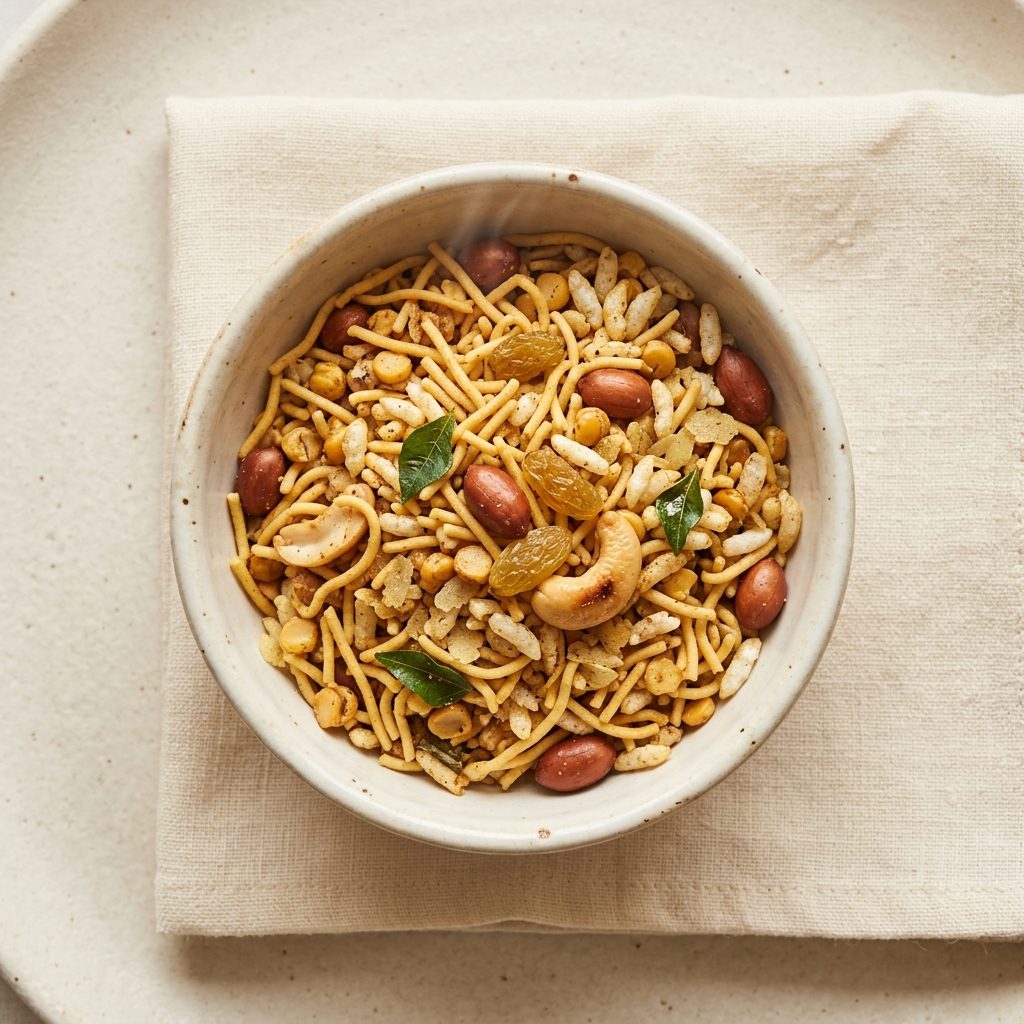
The problem is that the eye goes to whichever number is smaller, and on a snack pack that is almost always per serving. A namkeen showing 520 calories per 100 g and 156 calories per serving is not offering you a choice between the two. It is telling you a serving is 30 g, which is roughly a fistful, and that the 150 g pack in your hand holds close to 780 calories.
Always locate the serving size before you look at any number. It is usually printed in small type directly above the panel.
Serving sizes that match nobody
Once you start checking serving sizes, a pattern appears quickly.
- Biscuits are often declared per two or three pieces, which is not how anyone eats biscuits with chai.
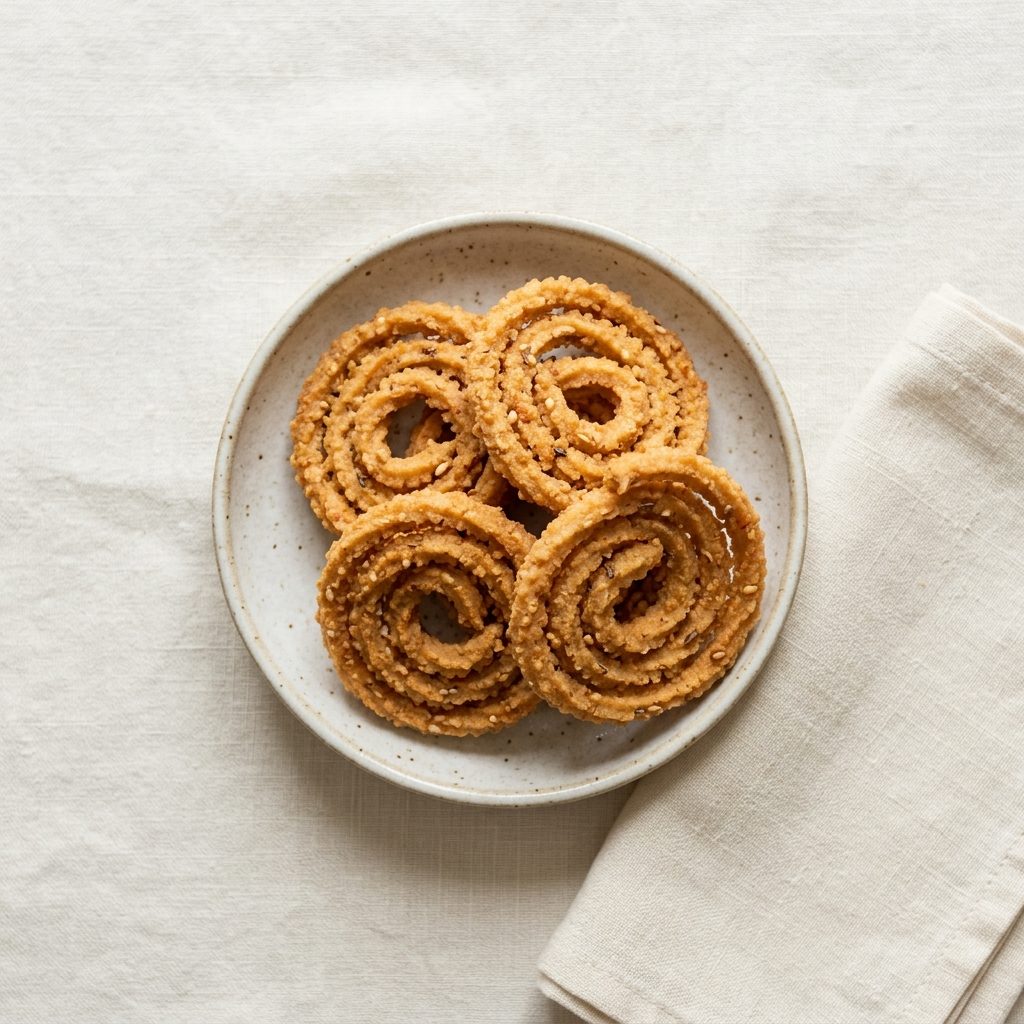
- Namkeen such as mixture or murukku is commonly declared per 30 g, when the small pack is 55 to 60 g and the family pack is 150 g or more.
- Breakfast cereal is typically 30 to 40 g, which is a fraction of a normal bowl. Weigh your usual bowl once and the number is often double.
- Beverages are frequently declared per 100 ml when the bottle is 250 or 600 ml.
- Ice cream is usually per 50 to 60 ml, roughly one small scoop.
None of this is deceptive in a legal sense. It is simply a definition that suits the manufacturer, and there is no rule that says it should match your habits.
The fix is the same as it is for tracking home-cooked food. Work out what you actually eat, once, and use that. If your cereal bowl is 70 g, double every number in the per serving column and use that figure permanently.
Added sugar, and the many names it goes by
Ingredient lists are ordered by weight, which gives manufacturers a straightforward incentive. Split sugar across several different sugars and no single one has to appear near the top.
Names to recognise as added sugar:
Sucrose, dextrose, glucose, fructose, glucose syrup, liquid glucose, high fructose corn syrup, corn syrup solids, invert sugar, invert syrup, maltose, maltodextrin, malt extract, barley malt, molasses, treacle, cane juice, cane syrup, fruit juice concentrate, honey, jaggery, gur, date syrup and caramel.
Jaggery and honey are worth a specific note, because Indian packaging leans on them heavily. They are marginally different in mineral content and glycaemic response from refined sugar, and they are still sugar in your calorie count. A product sweetened with jaggery is not a low sugar product.
The practical test is simple. Read the first three ingredients, then count how many sugar names appear anywhere in the list. Three or more different sugars in one product usually means the total is higher than the position of any single one suggests.
FSSAI now requires added sugars to be declared separately from total sugars on most packs, which makes this much easier than it used to be. Total sugars in a plain curd is lactose and is not something to worry about. Total sugars in a flavoured curd, or in a bottled mango lassi rather than a plain chaas, is mostly added.
Total fat, saturated fat and the trans fat rounding
The fat block has three separate lines and they are not interchangeable.
Total fat is the whole amount. At roughly 9 calories a gram it is the densest thing on the panel, which is worth knowing when a small number in grams produces a large number in calories.
Saturated fat is a subset of total fat. Indian packaged snacks fried in palm oil often carry a high proportion here.
Trans fat is the one to check for a specific reason. India capped industrially produced trans fat in oils and fats at 2 percent, which was a genuine public health win. But the declaration rounds down below a small threshold, so a pack can legally show zero while containing a trace.
The reliable check is not the panel, it is the ingredient list. If you see partially hydrogenated vegetable oil, hydrogenated vegetable fat or vanaspati, industrial trans fat is present in some amount whatever the zero on the front says. Our piece on fats, ghee and oil in Indian cooking covers what that actually means for home cooking.
The green and brown mark
The mark in the top left corner is one of the clearest pieces of Indian food regulation, and it is purely about ingredients.
A filled green circle inside a green square means the product contains no non-vegetarian ingredients, as FSSAI defines them.
A brown mark inside a brown square means it does. Newer packs use a brown triangle, following an amendment to the rules, while older stock still carries the brown circle. Both mean the same thing.
Two limitations are worth knowing. The mark says nothing at all about nutrition, so a green mark on a pack of biscuits is not a health signal. And it does not cover eggs consistently across all categories, so people who eat eggs but not meat still need to read the ingredient list.
The thirty second label check
You do not need to do this for everything. Do it once for each product you buy regularly, and you will never need to do it again for that product.
- Find the serving size. Small print above the panel. Compare it to what you actually eat.
- Identify which column you are reading. Per 100 g for comparing products, per serving for estimating a portion.
- Read the first three ingredients. They are most of the product by weight.
- Count the sugar names anywhere in the list, then check the added sugars line.
- Check total fat, and scan the ingredients for hydrogenated or vanaspati rather than trusting a zero trans fat claim.
- Look at sodium if you eat a lot of packaged snacks. It adds up faster than most people expect.
Claims on the front of the pack are marketing and are not part of this check. Multigrain does not mean whole grain. Baked not fried says nothing about sugar. Made with real fruit can mean a small percentage of concentrate. No added sugar can sit on a juice carrying 25 g of sugar per glass. Fortified means a vitamin was added, not that the rest of the product changed. None of these phrases are lies. None of them are answers either.
Why this matters more than it looks
Packaged food is the fastest growing part of the Indian plate, and it is the part where your intuition is weakest. You know roughly what went into your dal. You have no idea what went into a biscuit unless you read it.
Thirty seconds, once per product, closes that gap permanently.
Everything else on the pack is there to be liked. The panel on the back is the only part written to be true.
Calorie figures on this page are typical ranges, not lab values. Indian recipes vary enormously between kitchens, so a number that is right for one house is wrong for the next. Sehat keeps a confidence level and a source note on every entry rather than pretending a single figure is the truth. This is general information, not medical advice.
Common questions
What does per 100 g mean on an Indian food label?
It means the values shown apply to exactly 100 grams of the product, which lets you compare two products fairly. It is not the amount in the pack and it is not a suggested portion. If your pack is 35 g, you are eating roughly a third of the numbers in that column.
How do I find added sugar on an Indian label?
Look at the ingredient list, which is ordered by weight, and count the entries that are sugar under another name. Sucrose, dextrose, glucose syrup, invert sugar, maltodextrin, corn syrup, fruit juice concentrate, honey, jaggery and malt extract all count. FSSAI also requires added sugars to be declared separately in the nutrition panel on most packs.
What does the green dot on Indian food packaging mean?
A filled green circle inside a green square means the product is vegetarian, as defined by FSSAI. The brown equivalent, shown as a triangle on newer packs and a circle on older stock, means it contains non-vegetarian ingredients. The mark refers to ingredients only and says nothing about nutrition.
Can a product say zero trans fat and still contain trans fat?
Yes. The declaration rounds down below a small threshold, so a product with a trace amount can legally show zero. If the ingredient list includes partially hydrogenated oil, vanaspati or hydrogenated vegetable fat, some trans fat is present regardless of what the panel says.
Does no added sugar mean a product is low in sugar?
No. It means no sugar was added during manufacturing. A fruit juice with no added sugar can still carry 20 to 25 g of sugar per 250 ml from the fruit itself. Check the total sugars line in the nutrition panel rather than relying on the front of the pack.
Dishes mentioned

In the app
All of this, without the arithmetic.
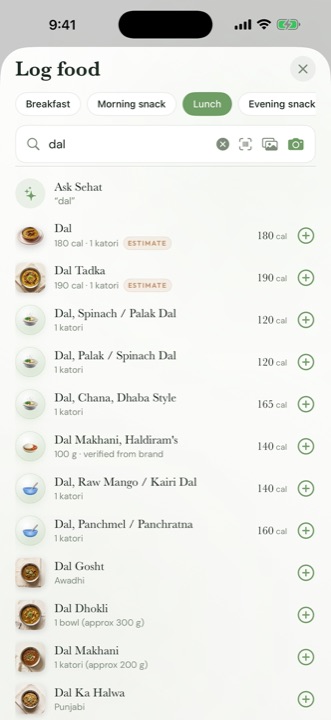
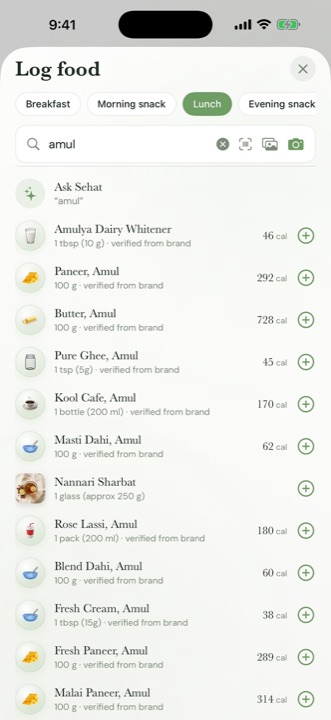
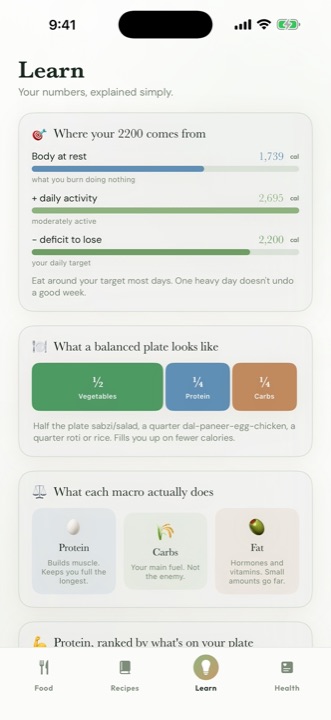
The world's most complete Indian calorie counter.
Over 10,000 foods and spellings.
Log dal, roti and biryani by voice, in Hinglish, in the portions your kitchen actually uses. An AI coach reads your day and guides you. No coaches. No calls. No spam.
Download free on the App StoreAndroid is on the way.
Calorie tracking
How to count calories in Indian food
A practical method for tracking dal, roti, sabzi and biryani without weighing anything. Portions, honest ranges, and the four habits that make a log actually stick.
Macros
Carbs in Indian food, and how many you actually need
Which Indian staples are carb-dense, how roti, rice, poha and upma compare, and the honest answer for anyone eating two rotis with every meal.
Calorie tracking
Seven calorie tracking mistakes that quietly ruin an Indian food log
Untracked ghee, four cups of chai, a generic dal entry and invisible weekends. The seven errors that make an Indian calorie log wrong, and the fix for each.