How many calories do I need in a day?
The short answer
Most Indian adults need somewhere between 1,600 and 2,600 calories a day to maintain weight, depending on size, sex and activity. Estimate yours with the Mifflin St Jeor formula for BMR, multiply by an activity factor to get TDEE, then adjust it using two to three weeks of your own data.
Key takeaways
- BMR is what your body burns at complete rest. TDEE is BMR multiplied by an activity factor, and TDEE is the number you actually eat against.
- The Mifflin St Jeor formula is the most reliable of the common equations, and it is simple enough to do on paper.
- A 32 year old man of 78 kg and 174 cm has a BMR near 1,710 and a lightly active TDEE near 2,350.
- Online calculators disagree because they use different equations and different activity multipliers, not because one of them is right.
- Treat the calculated number as a hypothesis. Two to three weeks of weight and intake data will correct it better than any formula can.
There is a number, and there is a false confidence about the number.
The number is worth having. It gives you a place to start and something to adjust from. What it is not is a fact about your body, and any calculator that returns 2,187 with two decimal places of certainty is overselling what it can possibly know.
Most Indian adults need somewhere between 1,600 and 2,600 calories a day to maintain their weight. Here is how to narrow that down to your own figure, and what to do when it turns out to be wrong.
BMR is what you burn doing nothing
Basal metabolic rate is the energy your body spends staying alive. Heart, lungs, brain, kidneys, body temperature, cell repair. It runs whether you are asleep or watching television.
For most people BMR is around 60 to 70 percent of the total daily burn, which surprises people who assume exercise dominates. It does not. The single largest determinant of BMR is how much of you there is, particularly lean mass, which is why heavier and more muscular people burn more at rest.
BMR alone is never your eating target. It is the base you build on.
The Mifflin St Jeor formula
Several equations exist. Mifflin St Jeor is the one most dietitians reach for, because it performs best across ordinary populations and it is simple enough to work out on paper.
Men: BMR = (10 x weight in kg) + (6.25 x height in cm) minus (5 x age in years) + 5
Women: BMR = (10 x weight in kg) + (6.25 x height in cm) minus (5 x age in years) minus 161
That is the whole thing. Same equation, different final step.
Worked example, one
A 32 year old man, 78 kg, 174 cm.
- 10 x 78 = 780
- 6.25 x 174 = 1,087.5
- 5 x 32 = 160
- 780 + 1,087.5 = 1,867.5, minus 160 = 1,707.5, plus 5 = 1,712.5
BMR is about 1,710 calories.
Worked example, two
A 29 year old woman, 62 kg, 160 cm.
- 10 x 62 = 620
- 6.25 x 160 = 1,000
- 5 x 29 = 145
- 620 + 1,000 = 1,620, minus 145 = 1,475, minus 161 = 1,314
BMR is about 1,310 calories.
Neither of these people should eat that amount. Both of them get out of bed.
TDEE is BMR times how much you move
Total daily energy expenditure is BMR plus everything else: walking, standing, fidgeting, commuting, training, and the energy your body spends digesting the food itself.
You get it by multiplying BMR by an activity factor.
| Activity level | Multiplier | What it looks like |
|---|---|---|
| Sedentary | 1.2 | Desk job, little deliberate movement, mostly seated day |
| Lightly active | 1.375 | Desk job plus training one to three days a week, or a lot of walking |
| Moderately active | 1.55 | Training three to five days a week, or a job on your feet |
| Very active | 1.725 | Hard training six or seven days a week |
| Extremely active | 1.9 | Physical labour plus daily training |
Take the man above. Desk job, gym three times a week, so lightly active at 1.375.
1,712.5 x 1.375 = 2,354. His maintenance is roughly 2,350 calories.
The woman above, same activity pattern: 1,314 x 1.375 = 1,807. Roughly 1,800 calories.
Most people overestimate this step. A gym session three evenings a week does not make an otherwise seated day moderately active. When in doubt, pick the lower multiplier. It is easier to add food later than to explain why the trend went the wrong way.
Why two calculators give you two answers
Put the same details into four websites and you will get four numbers, sometimes 400 apart. Nobody is lying to you.
- They use different equations. Harris Benedict, Mifflin St Jeor, Katch McArdle and the Schofield equations all model the same thing with different coefficients.
- They define activity differently. One site’s moderate is another’s light. That single mismatch is worth several hundred calories on its own.
- Body composition is invisible to them. Two people at 70 kg and 170 cm with very different muscle mass burn measurably different amounts, and no height and weight formula can see the difference.
- Individual variation is real. Two people matched on every input can still differ by ten percent or more in actual expenditure.
So the number a calculator gives you carries an error bar of a few hundred calories. Which is fine, as long as you treat it as such.
Treat the number as a hypothesis
This is the part that turns an estimate into something useful.
- Calculate your TDEE. Use Mifflin St Jeor and a conservative activity multiplier.
- Eat at that number for two to three weeks. Log honestly, including cooking oil and chai. Do not change anything else.
- Track your weight trend, not daily weights. Weigh most mornings and compare this week’s average against last week’s.
- Read the result. Stable weight means the estimate was good and that is your maintenance. Drifting up or down means the real figure sits below or above the calculation.
- Adjust by 100 to 200 calories and run another two weeks.
After a month you have something no calculator could have given you, which is a maintenance figure derived from your own body rather than a population average. That number is the foundation for everything else, including building a calorie deficit if that is your goal.
Step two only works if the log is honest, which in an Indian kitchen means the tadka counts. There is a full method in how to count calories in Indian food, and the leaks that quietly ruin the experiment are collected in calorie tracking mistakes.
Typical ranges for Indian adults
Broad bands, offered as a sanity check rather than a prescription.
- Indian men: maintenance commonly lands between 2,000 and 2,600 calories a day.
- Indian women: maintenance commonly lands between 1,600 and 2,100 calories a day.
Bigger, younger, more muscular and more active people sit above those bands. Smaller, older and more sedentary people sit below. If your calculation lands far outside, recheck your activity multiplier first, because that is where the error usually is.
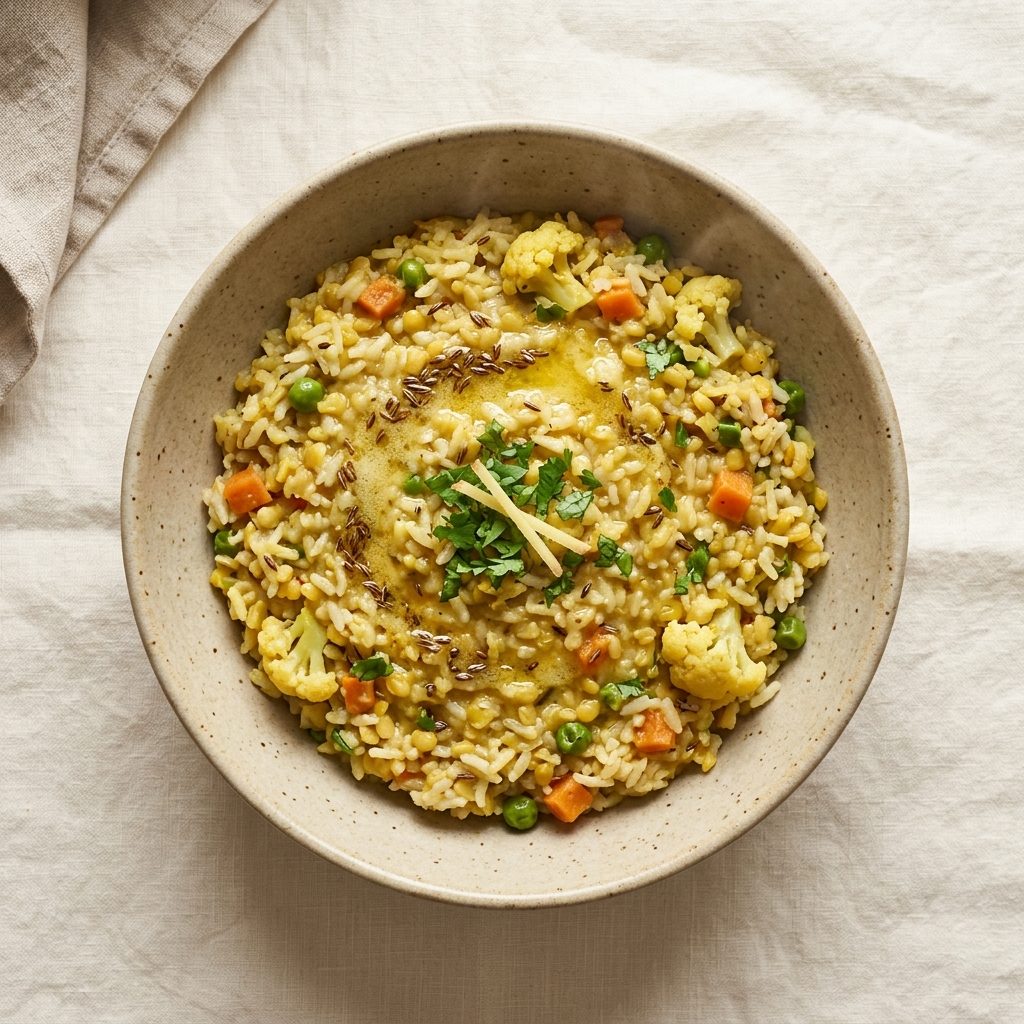
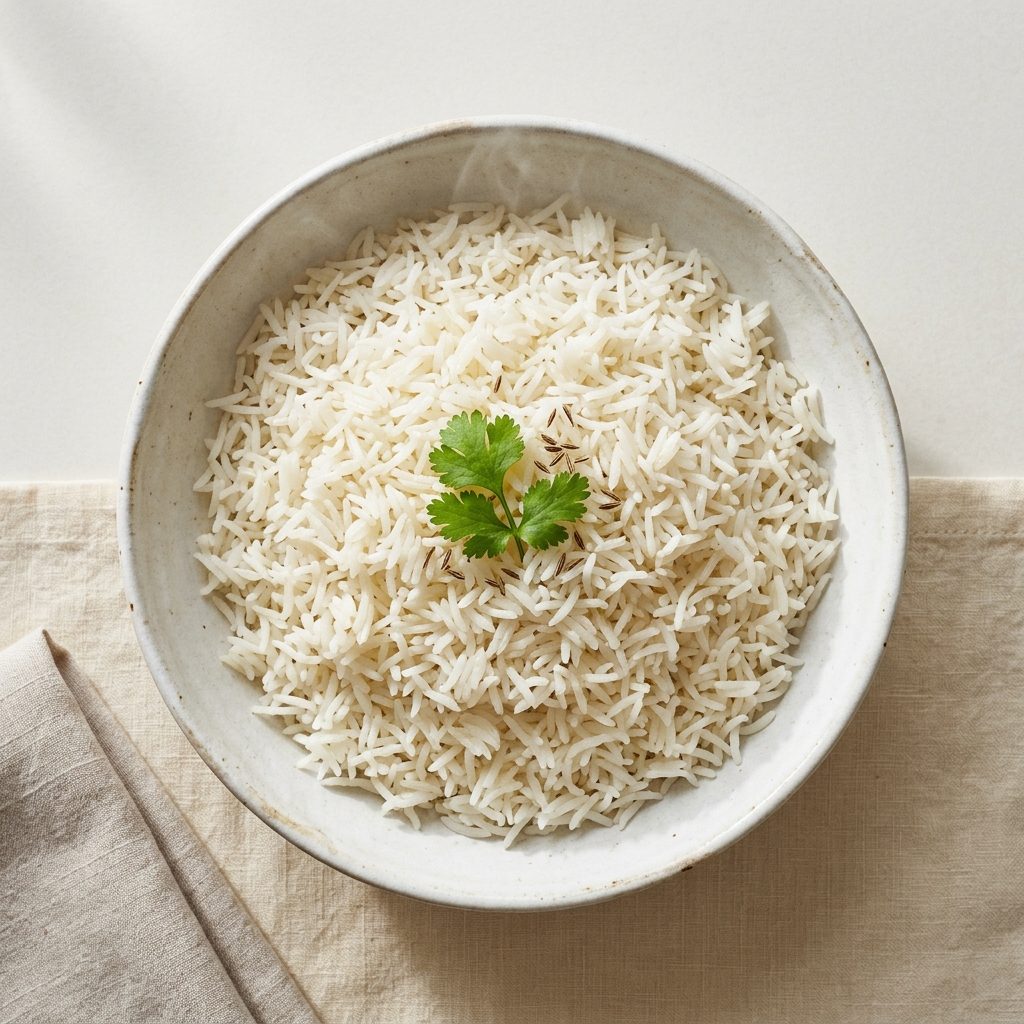
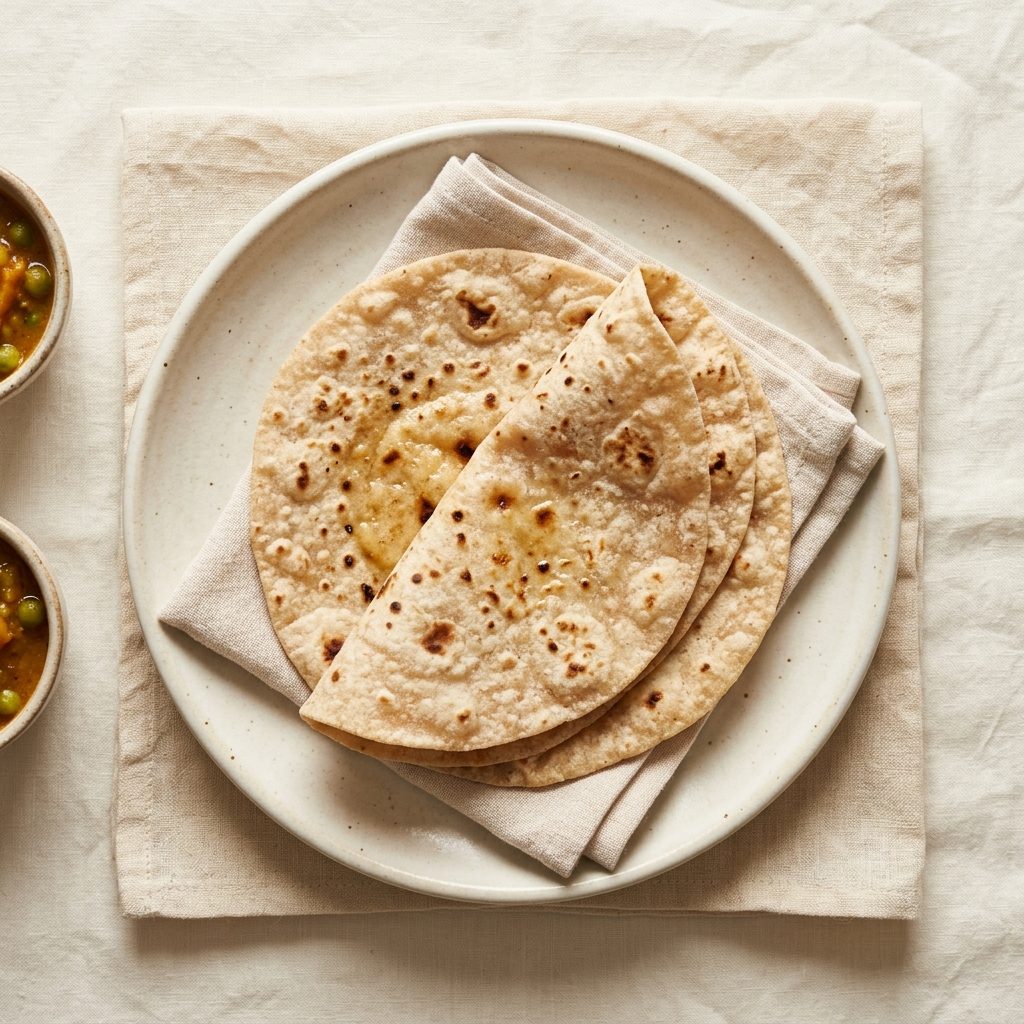
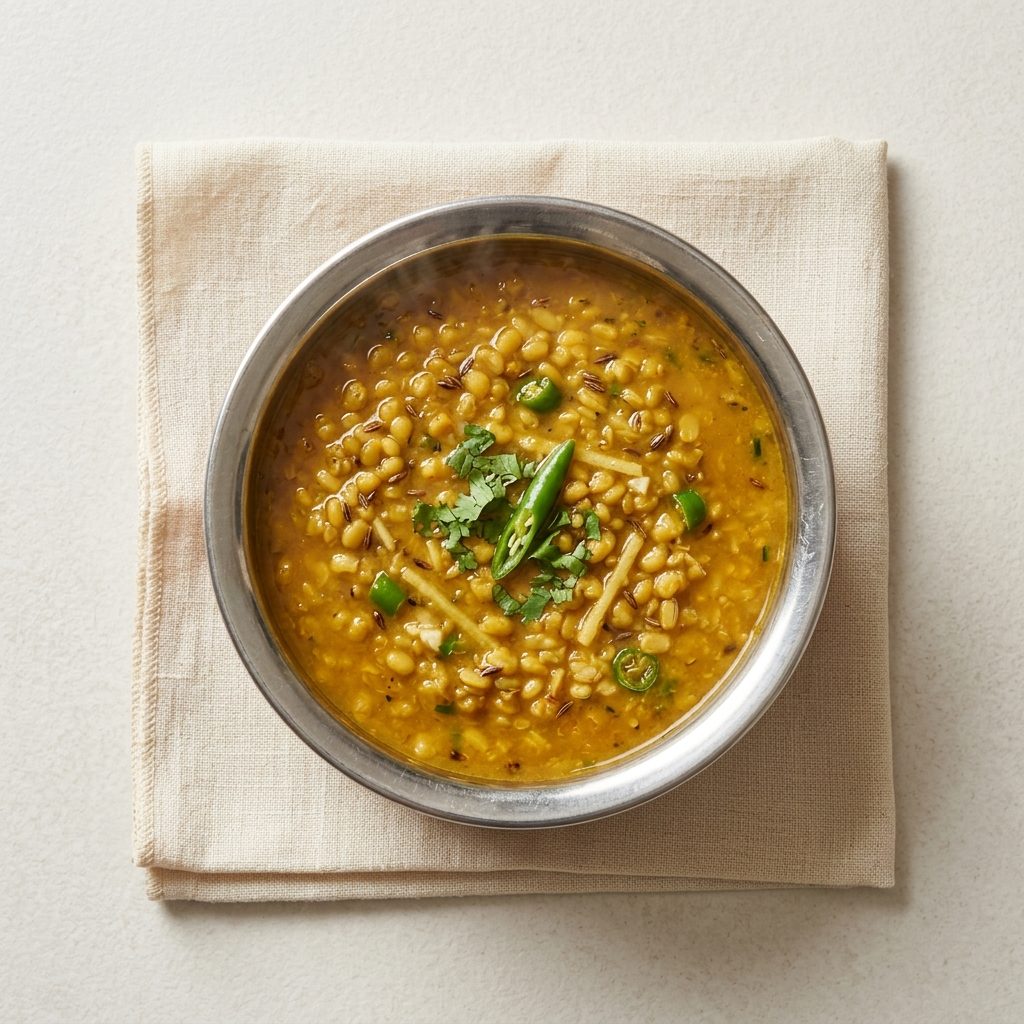
For context on what those numbers buy at an Indian table: a plate of khichdi with curd is a modest meal, three rotis with dal tadka and sabzi is an ordinary one, and a restaurant biryani plus a sweet can take a third of a day’s budget in one sitting. Knowing your number is what turns those from judgements into decisions.
Where the formula ends
A calorie target is a planning tool, nothing more. It does not know about your thyroid, your sleep, your medication, your stress or the week you spent travelling.
If you are pregnant or breastfeeding, managing a condition like diabetes, PCOS or thyroid disease, taking medication that affects appetite or weight, or you have a history of disordered eating, speak to a doctor before setting a target. A formula on a website is not equipped for any of that.
For everyone else, the honest version is this. Calculate the number, use it as a starting hypothesis, and let three weeks of your own data tell you what your body actually does.
The data is always right. The formula is only ever close.
Calorie figures on this page are typical ranges, not lab values. Indian recipes vary enormously between kitchens, so a number that is right for one house is wrong for the next. Sehat keeps a confidence level and a source note on every entry rather than pretending a single figure is the truth. This is general information, not medical advice.
Common questions
What is the difference between BMR and TDEE?
BMR is the energy your body uses at complete rest to run your heart, brain, kidneys and temperature. TDEE is your total daily burn, which is BMR plus movement, exercise and the energy used digesting food. TDEE is always higher, and it is the number you plan your eating around.
What is the Mifflin St Jeor formula?
For men, BMR equals 10 times weight in kilograms, plus 6.25 times height in centimetres, minus 5 times age in years, plus 5. For women the final step is minus 161 instead of plus 5. Multiply the result by an activity factor between 1.2 and 1.9 to get TDEE.
How many calories does an average Indian adult need?
Maintenance for Indian men commonly falls between 2,000 and 2,600 calories a day, and for Indian women between 1,600 and 2,100. Those are broad bands. Body size, muscle mass, job type and training load move an individual well outside them in either direction.
Why do calorie calculators give me different numbers?
They use different equations, and they define activity levels differently. One calculator's moderately active is another's lightly active, and that single choice can shift the result by 300 calories. None of them can see how much you actually move, which is the largest unknown in the whole estimate.
Should I eat my exercise calories back?
Usually not in full. Fitness trackers and gym machines tend to overstate calories burned, sometimes substantially. A common approach is to pick an activity multiplier that already accounts for your normal training, then leave the daily target fixed rather than adding calories back after every session.
Dishes mentioned
In the app
All of this, without the arithmetic.
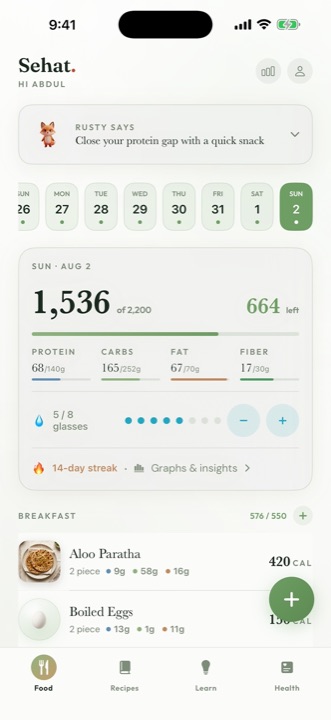
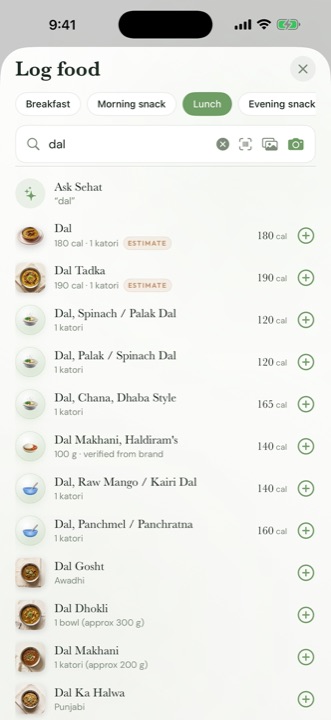
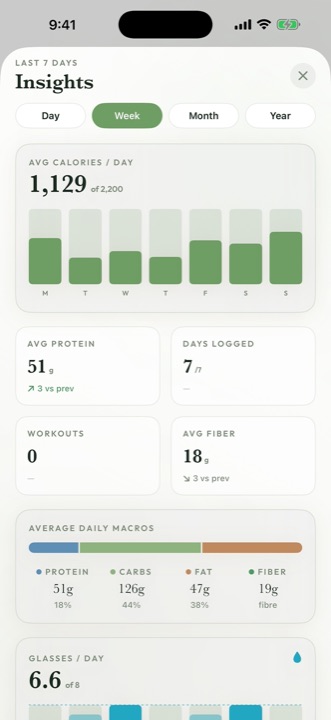
The world's most complete Indian calorie counter.
Over 10,000 foods and spellings.
Log dal, roti and biryani by voice, in Hinglish, in the portions your kitchen actually uses. An AI coach reads your day and guides you. No coaches. No calls. No spam.
Download free on the App StoreAndroid is on the way.
Calorie tracking
How to build a calorie deficit on an Indian diet
A calorie deficit does not require giving up dal, roti or rice. How to size one sensibly, adjust cooking fat and portions, and keep it going past week three.
Calorie tracking
How to count calories in Indian food
A practical method for tracking dal, roti, sabzi and biryani without weighing anything. Portions, honest ranges, and the four habits that make a log actually stick.
Macros
Macros explained, for people who eat Indian food
Protein, carbs, fat and fibre, explained against a real Indian plate. Why the thali runs carb-heavy, a sane starting split, and how to fix the protein gap.